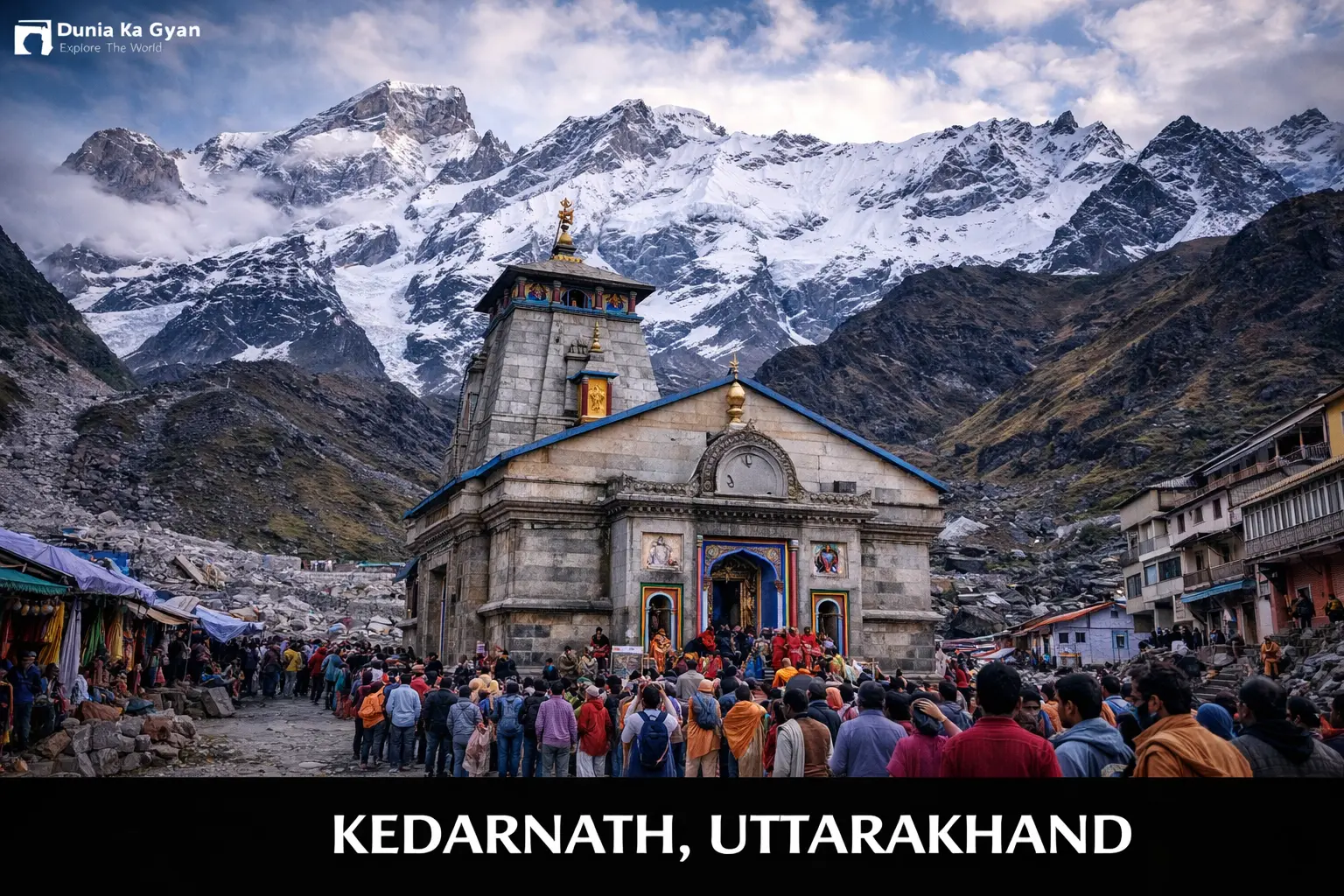
High in the Garhwal Himalayas of Uttarakhand stands one of the most powerful spiritual destinations in India, Kedarnath Temple. At an altitude of 3,583 meters, surrounded by towering snow-covered peaks and the flowing Mandakini River, Kedarnath is not simply a temple you visit; it is a journey you endure and remember for life.
It is one of the twelve sacred Jyotirlingas of Lord Shiva and a major part of the revered Char Dham Yatra. Every year, millions search for Kedarnath distance from Delhi, Kedarnath weather today, Kedarnath trek registration 2026, helicopter booking options, and the best time to visit.
This guide is built to answer everything deeply, clearly, and honestly so you can plan your Kedarnath Yatra 2026 with confidence.
History & Spiritual Significance of Kedarnath
Kedarnath’s history is deeply rooted in Hindu mythology. According to legend, after the Kurukshetra war, the Pandavas sought Lord Shiva to seek forgiveness for their sins. Shiva, avoiding them, took the form of a bull. When Bhima tried to catch him, the bull disappeared into the ground, leaving its hump visible at Kedarnath. The temple was later built at that sacred spot.
The present structure is believed to have been revived by Adi Shankaracharya in the 8th century. What makes Kedarnath even more remarkable is its survival during the devastating 2013 Uttarakhand floods. While destruction occurred everywhere around it, the temple stood firm, shielded by a massive boulder that diverted floodwaters. For many devotees, that moment reinforced their faith forever.
Kedarnath Temple Architecture & Unique Facts
The architectural brilliance of Kedarnath Temple makes it one of the most extraordinary ancient temples in India.
Stone Construction Without Mortar
The temple is built using massive interlocking grey stone slabs, placed without modern cement or mortar. Despite extreme weather conditions, it has stood strong for over 1,200 years.
The Sacred Shiva Lingam
Inside the sanctum lies a unique, irregularly shaped Shiva lingam approximately 6 feet tall, representing the hump of Lord Shiva in bull form.
Elevation & Structure
- Altitude: 3,583 meters
- Built on a large rectangular platform
- Snow-resistant Himalayan stone architecture
Survival During 2013 Floods
During the devastating 2013 Uttarakhand floods, a massive boulder diverted floodwaters away from the temple, preventing major structural damage, a moment many devotees consider miraculous.
The temple’s resilience, combined with its spiritual power, makes it one of the most revered Jyotirlingas in India.
Kedarnath Opening Date 2026 & Registration
The temple opens only for six months each year due to heavy winter snowfall.
Key Details for 2026
- Opening Date: 22 April 2026
- Closing Date (Tentative): 11 Nov 2026
- Official Announcement: On Maha Shivratri
- Winter Seat of Deity: Ukhimath
- Registration: Mandatory for all pilgrims
- Registration Modes: Online portal + biometric counters at Haridwar & Rishikesh
- Best Time to Register: At least 2–3 weeks before peak travel season
- Helicopter Booking: Only through the official IRCTC HeliYatra portal.
Without biometric registration, pilgrims cannot proceed beyond Sonprayag. During peak months, registration slots fill quickly.
Important Tips:
- Registration usually opens 1-2 months before the opening date.
- Keep your phone and photo ID (Aadhaar, PAN, etc.) ready for registration.
- Ensure you have a valid, pre-registered Yatra pass with a QR code to enter the temple area.
Kedarnath Temple Timings 2026 – Darshan & Aarti Schedule
Devotees visiting Kedarnath Temple should be aware of the official temple timings to plan darshan smoothly.
Kedarnath Temple Darshan Timings
- Morning Opening: 4:00 AM
- Morning Darshan: 6:00 AM – 3:00 PM
- Evening Darshan: 5:00 PM – 9:00 PM
- Temple Closing: Around 9:00 PM
Note: Timings may slightly vary depending on weather and temple administration decisions.
Kedarnath Aarti Time
- Morning Aarti: 4:00 AM – 5:00 AM
- Evening Aarti: 6:00 PM – 7:30 PM
Morning aarti is considered especially powerful, as the temple doors open in a serene Himalayan atmosphere.
VIP Darshan in Kedarnath
VIP darshan passes are sometimes available through official temple authorities. However, during peak Yatra season, priority is generally given to elderly pilgrims and special puja bookings.
Puja Booking Options
Devotees can book special puja, such as
- Rudrabhishek
- Maha Abhishek
- Laghu Rudra Puja
Puja bookings are typically available via the official Uttarakhand tourism or temple management portal before the Yatra season.
Kedarnath Distance From Delhi
One of the most searched travel queries is “Kedarnath distance from Delhi.”
The approximate road distance from Delhi to Gaurikund is 450–470 km. Including the 16–18 km trek, the total journey covers around 466–480 km.
Typical Route
Delhi → Haridwar → Rishikesh → Devprayag → Rudraprayag → Guptkashi → Sonprayag → Gaurikund → Kedarnath
Road travel takes 14–16 hours depending on traffic and weather conditions. Many travelers break the journey overnight at Rudraprayag or Guptkashi for comfort.
Kedarnath Distance from Haridwar
The total distance from Haridwar to Kedarnath Temple is approximately 240–250 km by road till Gaurikund, followed by a 16–18 km trek to the temple.
Route from Haridwar:
Haridwar → Rishikesh → Devprayag → Rudraprayag → Guptkashi → Sonprayag → Gaurikund → Kedarnath
Travel Time:
- Road Journey: 8–10 hours
- Trek: 6–8 hours
Many pilgrims prefer staying overnight at Guptkashi before starting the trek early morning.
Kedarnath Distance from Rishikesh
The distance from Rishikesh to Kedarnath is approximately 220–230 km by road till Gaurikund, plus the 16–18 km trek.
Travel Details:
- Road Time: 7–9 hours
- Last motorable point: Gaurikund
- Shared taxis and buses operate regularly during yatra season
Rishikesh is the most common starting point for the Kedarnath Yatra.
Kedarnath Route Map 2026 – Complete Travel Breakdown
The 2026 Kedarnath route follows National Highway 7 through the Garhwal Himalayas.
Step-by-Step Route:
Delhi → Haridwar → Rishikesh → Devprayag → Srinagar → Rudraprayag → Agastmuni → Guptkashi → Sonprayag → Gaurikund → Kedarnath
Important Points:
- Devprayag: Confluence of Alaknanda & Bhagirathi rivers
- Rudraprayag: Confluence of Mandakini & Alaknanda
- Sonprayag: Registration checkpoint
- Gaurikund: Trek starting point
Road conditions are generally good but narrow in mountain stretches. Landslides may occur during monsoon.
How to Reach Kedarnath
Reaching Kedarnath involves air, rail, and road travel followed by trekking.
By Air
- Nearest Airport: Jolly Grant Airport, Dehradun
- Distance to Sonprayag: Approximately 210 km
- Taxi and shared vehicle services available
By Train
- Nearest Railway Station: Rishikesh
- Major Alternative Railhead: Haridwar
- Direct trains available from Delhi and other major cities
By Road
- Well-connected mountain highway via NH-7
- Last motorable point: Gaurikund
- Regular buses and taxis from Haridwar and Rishikesh
From Gaurikund to Kedarnath
- Trek Distance: 16–18 km
- Average Duration: 6–8 hours
- Alternatives: Pony, palki, helicopter services
Kedarnath Trek – What It Truly Feels Like
The Kedarnath trek is moderate but demanding due to altitude and thin air. The route passes through Jungle Chatti, Bheembali, and Linchauli before reaching the base camp.
The first few kilometers feel manageable, but as elevation increases, breathing becomes heavier. It is important to walk slowly and steadily rather than rushing.
Facilities Available on the Kedarnath Trek Route
The 16–18 km trek from Gaurikund to Kedarnath is well-managed during Yatra season, with multiple facilities to support pilgrims.
Rest Shelters
Temporary resting camps and covered shelters are available at:
- Jungle Chatti
- Bheembali
- Linchauli
These allow pilgrims to pause and regain energy.
Medical Camps
Government-operated medical camps are stationed at regular intervals. Basic first aid, oxygen cylinders, and emergency support are available during peak season.
Food & Water Stalls
Tea stalls, small eateries, and packaged water shops operate along the trek route. Simple meals like khichdi, Maggi, and tea are commonly available.
Oxygen Availability
Due to high altitude (3,583 meters), some pilgrims may experience breathlessness. Oxygen cylinders are available at certain checkpoints and at the Kedarnath Base Camp medical center.
Despite these facilities, physical preparation is highly recommended before attempting the trek.
My Personal Experience
I began my trek before sunrise. The air was cold, and the mountain silence felt powerful. Initially, I was excited and energetic. But by the halfway mark, fatigue set in. I sat at a tea stall near Linchauli, watching elderly pilgrims climb with remarkable determination.
That moment changed my mindset. Kedarnath is not about speed, it is about surrender.
When I finally saw the temple against the backdrop of the Kedarnath peak, something shifted inside me. The exhaustion disappeared. During morning aarti, as bells echoed through the valley and cold wind brushed against my face, I felt a rare kind of peace.
The journey prepares you for that moment.
Kedarnath Weather Today & Best Time to Visit
Weather conditions in Kedarnath change rapidly due to high altitude.
Seasonal Breakdown
- May–June: 5°C to 18°C, snow visible in early season, peak crowd
- July–August: Heavy rainfall, landslide risk, unpredictable travel
- September–October: Clear skies, pleasant temperatures, less crowd
- November–April: Heavy snowfall, temple closed
Weather Travel Tips
- Always check Kedarnath weather today before starting the trek
- Carry thermals even during summer
- Keep rain protection handy
- Avoid monsoon season if possible
September is often considered the best month for clear views and manageable crowds.
Kedarnath Temperature Month-Wise (2026 Guide)
| Month | Day Temperature | Night Temperature | Travel Condition |
| April | 5°C – 12°C | -2°C to 3°C | Cold, snow possible |
| May | 7°C – 18°C | 0°C to 5°C | Ideal, peak season |
| June | 10°C – 20°C | 5°C – 8°C | Pleasant, crowded |
| July | 8°C – 15°C | 5°C – 7°C | Heavy rainfall |
| August | 8°C – 14°C | 4°C – 6°C | Landslide risk |
| September | 5°C – 15°C | 2°C – 5°C | Clear skies, best views |
| October | 3°C – 12°C | -1°C to 3°C | Cold but peaceful |
| November–March | Below 0°C | Heavy snowfall | Temple closed |
Accommodation Options in Kedarnath
Accommodation near Kedarnath is simple but sufficient. Options include GMVN guest houses, private lodges, dharamshalas, and tent accommodations.
Rooms are basic, with essential facilities. Luxury hotels are not available due to altitude and weather constraints.
Advance booking is strongly recommended during May and June. If traveling with elderly family members, ensure you secure ground-floor rooms when possible.
Activities to Do in Kedarnath
While darshan remains central, Kedarnath offers more than just temple visits.
Spiritual Activities
- Attend early morning aarti
- Attend evening aarti
- Sit quietly for meditation near the temple complex
Nearby Exploration
- Visit Bhairavnath Temple (1 km uphill, panoramic views)
- Trek to Vasuki Tal (8 km from temple, for experienced trekkers)
- Explore Kedarnath Base Camp region
Experiential Moments
- Capture sunrise over the Himalayas
- Witness snowfall in early May
- Spend quiet reflection time by the Mandakini River
Nearby Places to Visit in Kedarnath
Apart from seeking blessings at Kedarnath Temple, the surrounding Garhwal Himalayan region offers breathtaking landscapes, mythological landmarks, and peaceful spiritual retreats. Many pilgrims extend their Kedarnath Yatra by exploring these nearby attractions.
1. Bhairavnath Temple
Distance from Kedarnath Temple: Approx. 1 km uphill
Trek Time: 20–30 minutes
Situated on a hilltop above Kedarnath, Bhairavnath Temple is dedicated to Lord Bhairav, a fierce manifestation of Lord Shiva. According to local belief, Bhairav protects Kedarnath during winter months when the main temple remains closed and the deity is shifted to Ukhimath.
The short uphill walk rewards visitors with panoramic views of the Kedarnath valley and snow-covered Himalayan peaks. Sunrise and sunset views from here are especially breathtaking.
This is one of the most recommended short hikes near Kedarnath.
2. Vasuki Tal
Distance from Kedarnath: Approx. 8 km
Trek Difficulty: Moderate to difficult
Best Time: May–June & September
Vasuki Tal is a stunning high-altitude glacial lake located at an elevation of around 4,135 meters. The lake is surrounded by dramatic mountain peaks, including views of the Chaukhamba massif.
According to mythology, Lord Vishnu is believed to have bathed in this lake. The trek to Vasuki Tal starts from Kedarnath and is suitable for physically fit trekkers due to steep and rocky terrain. The crystal-clear water reflecting snow peaks makes it one of the most scenic spots near Kedarnath.
3. Gaurikund
Distance from Kedarnath: 16–18 km (trek route starting point)
Gaurikund is the base camp and last motorable point before the Kedarnath trek begins. It holds deep mythological significance as the place where Goddess Parvati (Gauri) meditated to win Lord Shiva’s heart.
The town is known for:
- A natural hot water spring (though partially affected after 2013 floods)
- Gauri Temple dedicated to Goddess Parvati
- Trek registration and check-post facilities
Most pilgrims stay overnight here before starting the early morning trek to Kedarnath.
4. Triyuginarayan Temple
Distance from Kedarnath: Approx. 25 km (via Sonprayag)
Best for: Spiritual and mythological exploration
Triyuginarayan Temple is believed to be the sacred wedding site of Lord Shiva and Goddess Parvati. The temple features an eternal flame (Akhand Dhuni), which is said to have been burning since their divine marriage.
The temple architecture resembles Kedarnath’s stone structure, and the surrounding Himalayan scenery adds to its peaceful charm.
Couples often visit this temple seeking blessings for marital harmony.
5. Guptkashi
Distance from Kedarnath: Approx. 45–50 km
Ideal Stay Point Before Trek
Guptkashi is a scenic town located on the route to Kedarnath. It serves as a major stopover for pilgrims due to better accommodation options and road connectivity.
Key attractions in Guptkashi:
- Vishwanath Temple (dedicated to Lord Shiva)
- Ardhnarishwar Temple
- Views of Chaukhamba peaks
Helicopter services to Kedarnath also operate from nearby Phata and Sersi, making Guptkashi a convenient base for travelers.
Kedarnath Helicopter Services
Helicopter services operate from Phata, Guptkashi, and Sersi. Flights are weather-dependent and fill up quickly during peak season. Advance booking is highly recommended. Same-day return options are available but may feel rushed. If possible, stay overnight for a deeper experience.
Kedarnath Helicopter Price 2026 (Estimated)
| Departure Point | One-Way Price (Approx.) | Same-Day Return | Duration |
| Phata | ₹2,500 – ₹3,500 | ₹5,000 – ₹7,000 | 8–10 mins |
| Sersi | ₹2,500 – ₹3,500 | ₹5,000 – ₹7,000 | 8–10 mins |
| Guptkashi | ₹3,500 – ₹4,500 | ₹6,500 – ₹8,500 | 10–12 mins |
Prices are regulated by Uttarakhand authorities and may change in 2026.
Helicopter booking opens online before the yatra season and fills quickly during May–June.
Essential Travel Information
- Nearest Bus Stand: Sonprayag
- Nearest Railway Station: Rishikesh
- Nearest Airport: Jolly Grant Airport
Mobile network connectivity is limited. BSNL and Jio function intermittently. ATMs are available till Guptkashi; carry sufficient cash. Medical aid camps are available during pilgrimage season along the trekking route.
Mobile Network & Internet in Kedarnath
Connectivity in Kedarnath is limited due to its high-altitude Himalayan location.
Best Working Networks
- BSNL (most stable)
- Jio (works intermittently)
- Airtel (limited connectivity)
Internet & WiFi
WiFi is not widely available near the temple area. Data signals are weak and unreliable.
UPI & Digital Payments
UPI works in larger towns like Guptkashi and Sonprayag. However, near Kedarnath Temple, digital payments may fail due to poor networks. Carry sufficient cash for food and small expenses.
Safety & Practical Advice
Wear sturdy trekking shoes with strong grip. Begin the trek early morning to avoid weather shifts. Stay hydrated but avoid overeating during ascent. Carry identity proof and registration documents at all checkpoints.
Most importantly, respect the fragile Himalayan ecosystem. Avoid plastic waste and follow local guidelines.
Kedarnath Trip Cost from Delhi – Estimated Budget
Planning your Kedarnath Yatra 2026 budget in advance helps avoid unexpected expenses. Below is an approximate cost breakdown per person.
1. Transport (Delhi to Kedarnath Round Trip)
- Bus/Shared Taxi: ₹2,000 – ₹4,000
- Private Car: ₹8,000 – ₹15,000
2. Accommodation (2–3 Nights)
- Budget Stay: ₹800 – ₹2,000 per night
- GMVN Guest House: ₹1,500 – ₹3,000 per night
3. Food Expenses
- ₹400 – ₹800 per day
4. Registration Fee
- Free (Biometric registration mandatory but no major charge)
5. Pony/Palki (Optional)
- Pony: ₹3,000 – ₹5,000 (one way)
- Palki: ₹6,000 – ₹10,000 (one way)
6. Helicopter (Optional)
- ₹5,000 – ₹8,500 (same-day return approx.)
Estimated Total Budget:
- Budget Trip: ₹6,000 – ₹10,000
- Comfort Trip: ₹12,000 – ₹20,000
Costs vary based on travel style and season.
Conclusion
A journey to Kedarnath Temple is never just about reaching a destination. It is about the road from Delhi, the slow mountain turns, the cold air at Gaurikund, and the steady climb toward something greater than yourself. The 16-kilometer trek tests your patience and stamina, but it also clears your mind in a way few places can.
When you finally stand before the ancient stone temple, surrounded by towering Himalayan peaks, everything becomes quiet, not outside, but within. The chants, the bells, and the crisp mountain wind create a moment that feels timeless.
Planning your Kedarnath Yatra 2026 carefully from registration to weather checks ensures a smoother journey. But what truly makes it unforgettable is the experience itself.
Kedarnath does not just offer darshan. It offers perspective, humility, and a memory that stays long after you return home.
Frequently Asked Questions
The temple is expected to open in 22 April or May 2026, with the official announcement made on Maha Shivratri.
Approximately 466–480 km, including the 16–18 km trek from Gaurikund.
Yes, biometric registration is compulsory for all pilgrims.
May–June and September–October are considered ideal months.
Yes, helicopter services operate from Phata, Guptkashi, and Sersi.
People are also reading: